Robust and Agile Quadrotor Flight via Adaptive Unwinding-Free Quaternion Sliding Mode Control
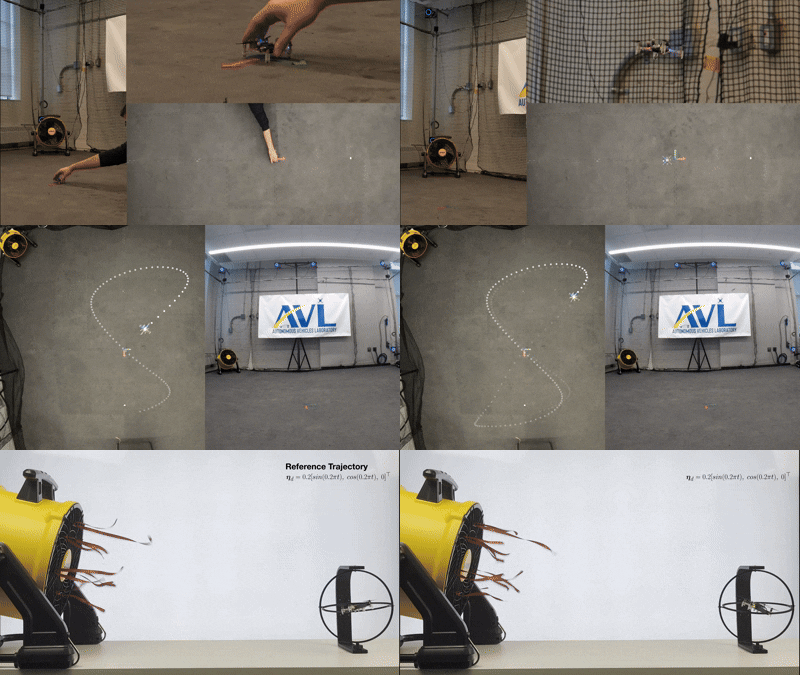 Image credit: Paper
Abstract
This article presents a new adaptive sliding-mode control (SMC) framework for quadrotors that achieves robust and agile flight under tight computational constraints. The proposed controller addresses key limitations of prior SMC formulations, including, first, the slow convergence and almost-global stability of SO(3)-based methods, second, the oversimplification of rotational dynamics in Euler-based controllers, third, the unwinding phenomenon in quaternion-based formulations, and fourth, the gain overgrowth problem in adaptive SMC schemes. Leveraging nonsmooth stability analysis, we provide rigorous global stability proofs for both the nonsmooth attitude sliding dynamics defined on S3 and the position sliding dynamics. Our controller is computationally efficient and runs reliably on a resource-constrained nano quadrotor, achieving 250 Hz and 500 Hz refresh rates for position and attitude control, respectively. In an extensive set of hardware experiments with over 130 flight trials, the proposed controller consistently outperforms three benchmark methods, demonstrating superior trajectory tracking accuracy and robustness with relatively low control effort. The controller enables aggressive maneuvers, such as dynamic throw launches, flip maneuvers, and accelerations exceeding 3 g, which is remarkable for a 32-gram nano quadrotor. These results highlight promising potential for real-world applications, particularly in scenarios requiring robust, high-performance flight control under significant external disturbances and tight computational constraints.
Add the publication’s full text or supplementary notes here. You can use rich formatting such as including code, math, and images.

Amin Yazdanshenas
PhD Student
My research interests include Autonomous Aerial Robotics, Control Therory, Computer Vision, and Artificial Intelligence